If you follow groups or forums where hams ask for help with equipment issues, you may have noticed that transmitters show a pronounced tendency to fail while they are being used for digital (data) modes. It seems that people often forget that amateur transceivers are not designed to transmit at full power for longer periods without enough breaks. Some digital modes may make radios do just that.
This proof-of-concept device may help save the radio. It connects to the COM port of the radio and continuously monitors the transmit-VFO frequency, using CAT commands. The Arduino program contains a list of frequency ranges used for digital modes. (They are relatively narrow.) If the transmit-VFO frequency is found to be within any of these ranges, the device will immediately command the radio to lower the output power to a safe level (set also in the program) while the previous (higher) value is stored in EEPROM and the buzzer sounds an ‘L’ in Morse code. The device will then continue to monitor the power level and will not allow any increase until the frequency is back out of the ‘risky’ ranges. Only then is the previous level of output power automatically restored and the buzzer sounds an ‘H’.
Really, modern digital modes are all about low-power DXing, they were literally made for that purpose.

The hardware is minimal: an Arduino Nano, an RS232/TTL converter on a cable, and an (optional) active buzzer, that is all. A suitable enclosure would be no bigger than a pack of cigarettes.
The way the device is powered must guarantee that it is on whenever the radio and the computer are on. The radio must have an unused RS-232 connector for CAT.
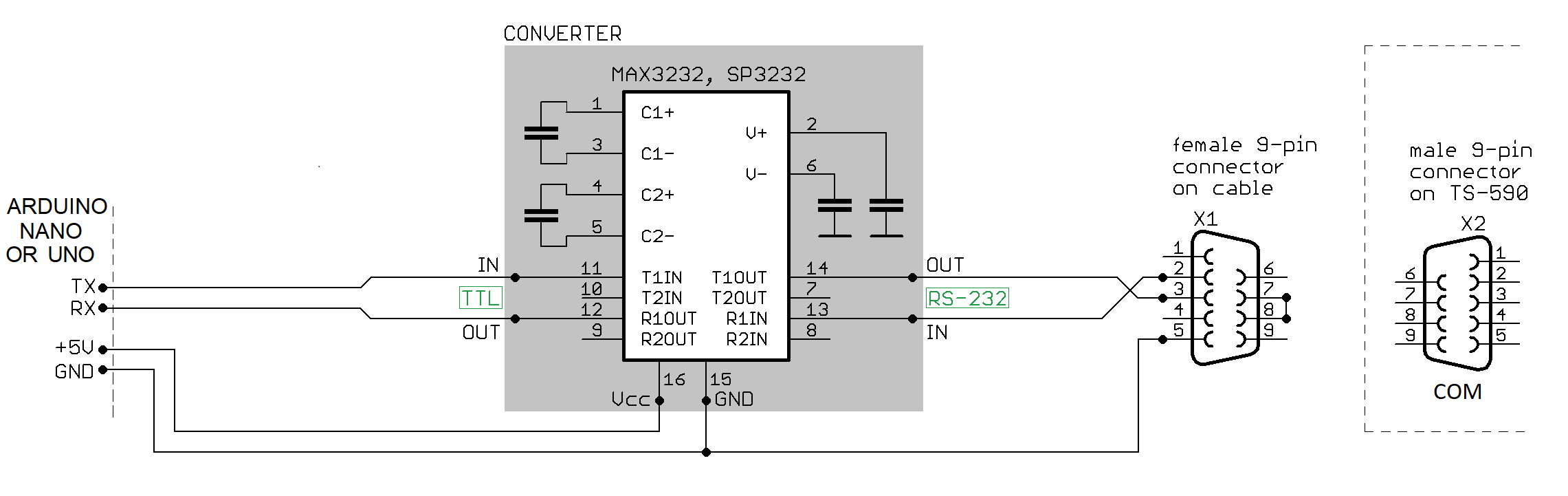

The device was tested with the Kenwood TS-590SG and the Yaesu FT-991A. It seems to work well with both radios. By the way, the USB port on the TS-590SG was simultaneously connected to the computer running a logging program, also using CAT, with no issues.
It should also work with some other Kenwood and Yaesu models (see program/sketch).
Arduino sketch:
DigiRadioGuard_0_7.ino


